


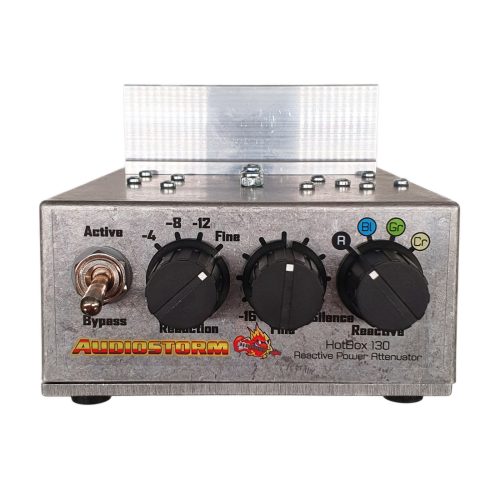
Reactive tone comes from your amp’s output transformer interacting with a load and it doesn’t actually care if that load is a speaker, a reactive attenuator or a resistive one, because in all cases it’s still pushing that high voltage tube energy through a magnetic field and you still get sag and feel and all the important details you love so much about your amp in all cases, without exception. Great resistive attenuators are big, bold, bright and full of energy.
So what makes a great resistive attenuator? We think simplicity, ruggedness, smart design choices and quality parts are key.
Simplicity: Two modes. Studio is a fixed, nailed down reduction. This lets you tune your amp in for that perfect recording or miked-up tone and know that when you flick our HotBox you can get on with playing, secure in the knowledge it’s the same volume and tone night-after-night. This mode also has the highest purity and clarity of signal we could design in. Fine mode gives you perfectly smooth control from ‘moderate reduction’ down to silence. Whether you want 1 watt or 0.1 watt to reach your speaker, it’s there to give you that fine detail control you need to get maximum satisfaction when noise is an issue.
Ruggedness: We over-engineer everything. It’s all so far beyond rating you wont believe it. That big toggle switch? Good for about 1500 watts. The resistors? we’ve got a total of redacted watts worth of dissipation in there. Yes, it’s more than advertised, but that’s how you build headroom. Of course the chassis is die cast aluminium, of course there’s a big heatsink, no poorly conducting steel here to hide away cheap parts that are burning up and burning out. We wear our colours on our skin.
Design choices: The ohms of all the parts inside matters too, because your amp is interacting with them so when we make them higher it gets warmer, and smaller it gets brighter, and we’ve sat down and gone through hundreds of tweaks before settling on our chosen values. heat dissipation too, yes our units can get hot with a full Marshall stack, but they will survive that just fine and with a smaller amp barely get warm even without fans.
Quality: Point-to-point, hand-soldered with vibration resistant Cobalt solder, solid copper core wire and heat-resistant flexi wires. Nothing but top quality Arcol resistors (world leaders, their parts are used inside nuclear reactors, space ships and military technology). Also Neutrik jack sockets, of course, CTS pots and carefully chosen top-quality elements throughout.
Specifications
- Suitable for any valve amplifier up to 120 watts.
- Dual mode with fixed (Studio) and variable (Jam) settings.
- Works as a Dummy Load (Set volume to zero in Jam mode).
- Available in 4, 8 and 16 ohm versions (2 ohms on request).
- True bypass to let your full volume through for A/B comparisons in the studio.
- Designed and built in Manchester, UK using premium components.
- Dual speaker outputs so you don’t have to daisy chain your speaker cabs.
- Lifetime warranty.
Why resistive can sometimes sound better* than reactive…The real reason most resistive attenuators sound bad is not the technology, it’s poor quality parts and bad design, because the companies who make budget gear have no interest in doing a good job, purely about hitting that bottom line to maximise profits. The real truth is that resistive attenuators can sound amazing and might be exactly what you need and are looking for!When a transformer pushes energy into a reactive load, it’s a bit like pushing a spring (valve power) into a variable sponge (the speaker or reactive load). Some bits of that sponge are quite hard (usually the lower mids) so the sponge gets pushed a long way (louder). And some bits are very soft (usually the high frequencies) so even a strong push doesn’t make the sponge move much (quieter) and this is why a lot of reactive attenuators (or speakers, sometimes) can be muddy, because if the spring is soft and the sponge is soft then the combined force barely moves the sponge at all.
Queue the resistive attenuator! Now your spring (amp and transformer) is pushing into a stiff block of rubber (the resistive attenuator) so you still get all the richness and compression of that spring but it’s no longer fighting a useless floppy sponge, instead it has a solid, firm load to move around. The result is that you get a much more even, studio-like tone. Your lows and highs are firm and solid and extended, the power of your amplifier is fully unlocked because it has a firm load to drive into, but you still have the compression of that tube and transformer chain so you don’t lose feel. In simple terms, a good resistive attenuator makes your amp sound bright, clear and forward in the mix. And sometimes that’s exactly what you want.
*So what makes a bad resistive attenuator? Well, firstly, an over-reliance on ‘rheostats’. These are big coils of wire with a wiper contact, and by themselves are super useful (our Fine control is actually a mini rheostat) but if you make them too big they become inductive and suck away the high end (soft sponge), and if you put too much power through them they become hot and their resistance fluctuates (unstable sponge) giving you a sound that changes as you play. If you see one of those ‘one knob wonders’ personally I’d steer clear. The second thing are cheap far-east resistors: We’ve demoed those clone parts and can hear the A/B difference, it’s not cork sniffing, they really do just sound poor. It’s hard to pin down exactly why but we think it’s just poor quality metal, and the fact they are ‘wire wound’ means they are a coil of wire so they will be prone to coil and heat type sponge-problems to some degree if not built exactly to spec. Plus they burn up. There’s no headroom on those, and often they can’t even reach spec. let alone surpass it.


Adam Bradley –
Great attenuator!! Built like an absolute tank, yet very delicate on my tone. It sees some amount of abuse and does not seem to mind.
Dave Aird –
Really like this .a great edge of break up sound at manageable volumes .Doesn’t colour the tone either .I connected it wrong originally and fried the volume pot and Sean very kindly replaced it .I’d like to claim credit that due to my mistakes he’s now added a red colour where the amp input is !
Francis Gorini –
Best attenuator I’ve even owned. I’ve had a few, including Weber Mass Lite and the very popular Jettenuator and Bugera PS1. With the HotBox 120 tone sucking is gone. Tried with Orange, Marshall and Fender amps. Incredibly easy to dial exactly the amount of attenuation I want while the other attenuators give me a volume that is either too low or too loud and suck tone. And when you set the HotBox to 0 no sound comes out. I can’t say the same for any of the others I mentioned.
Ordered and got it the following day. Top notch company and product.
Dave Roberts –
Works as advertised. Used with multiple Amps, 1979 Park nonmaster volume, Ceriatone AH-50, Budda SD45.
I may get another for my other Amps. Quick delivery as well.
Andy Gonzalez –
I’ve just been bought a HotBox 120 and it’s a great piece of gear.
I play low wattage combos (12w, 15w and 18w) but in my flat they’re still way too loud for home practice at any volume setting over about 2.
I have one attenuator already and it’s very good but it only takes amps up to 15W and it has fixed attenuation settings, the lowest of which isn’t quite low enough to push the amps into breakup.
After seeing the HotBox mentioned favourably on a few forums, I decided to take the plunge and I’m every glad I did.
It’s solid, sturdy, clearly labelled and very simple to use.
The dial turns smoothly and the switches feel solid.
After an hour and a half of playing, the HotBox is barely warm to the touch.
I have it set at a whisper over zero, amps at about 7 and they sound clear and crisp with and without fuzz and overdrive pedals – not a hint of muddiness.
An excellent attenuator at a good price. No unnecessary bells and whistles, it just does what it’s supposed to do and it does it very well.
Mikko –
Perfect buddy to my 40w 68 custom pro reverb.It’s 2 o’clock at night and i’m playing with beautyfull tone in my apartment.
Well built great product worth every penny.Happy Happy.
Gabriel Sanchez (verified owner) –
Perfect match for my EHX Mig 50. Even at lower volume the tone remains nice and crisp and the volume control is smooth with no sudden jumps in sound.